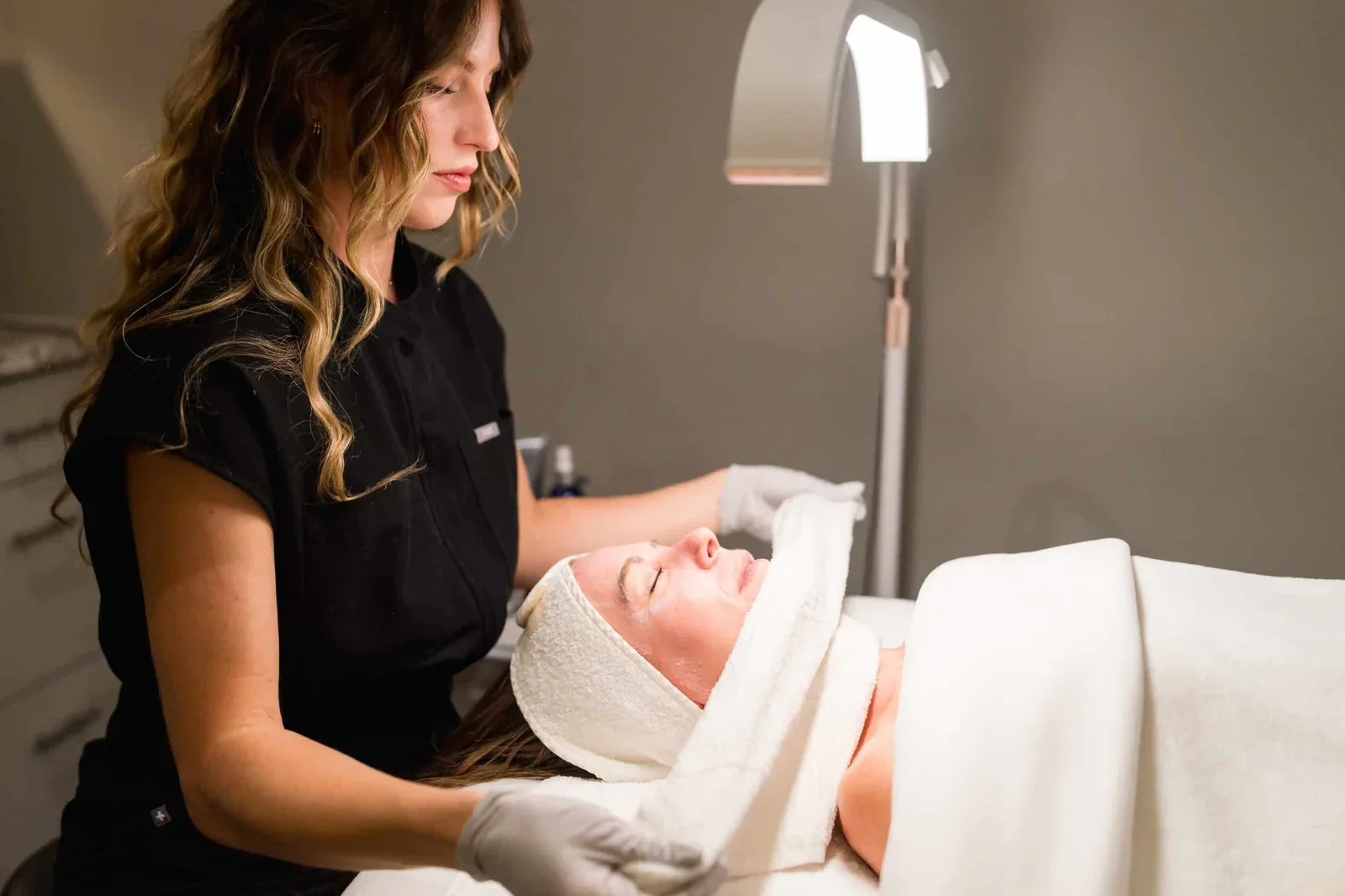

PDRN is the ingredient behind the "salmon DNA" and "salmon sperm facial" searches, and it is also the thread that runs through the regenerative side of our menu. At Banyan & Bamboo in Austin, we use it in Light Eyes Ultra, in the Mermaid Facial, and in PDRN microneedling, and we pair it with Sculptra when a patient wants structure and skin quality addressed together. This guide explains what PDRN is, what it does once it is in the skin, how each delivery method differs, and why it sits at the center of how we think about aesthetics.
Quick Summary: PDRN (polydeoxyribonucleotide) is a purified DNA fragment from salmon that signals skin cells to repair, build collagen and elastin, and calm inflammation. We deliver it three ways in Austin, ordered by depth: mesotherapy injections for the under-eye (Light Eyes Ultra, from $250), the Mermaid Facial ($399), a stamp-infused mesotherapy treatment at 0.5 mm that reaches the middle layer of the skin, and PDRN microneedling (the Mermaid Lift, a series of 3), which goes deepest. Sculptra ($900 per vial) rebuilds structure underneath. Together they form a regenerative plan that improves your own tissue over months.
What Is PDRN?
Polydeoxyribonucleotide is a chain of DNA fragments, purified from salmon because the structure is close enough to human DNA to be recognized by our cells and well tolerated. It has been used in medicine for decades to speed wound healing, support tissue grafts, and treat conditions where the body's repair process needs a push. Aesthetic medicine adopted it for the same reason: it tells skin to repair itself.
Once PDRN reaches the dermis, it does three things. It binds a receptor on cells (the adenosine A2A receptor) that switches on tissue repair. It gives fibroblasts, the cells that manufacture collagen and elastin, raw material and a reason to work. And it calms inflammation, which is why skin recovers faster after procedures when PDRN is part of the treatment. The visible outcome builds over weeks: firmer texture, better hydration from within, softer fine lines, and a more even tone.
The professional PDRN we use is Toskani, a pharmaceutical-grade formulation. The concentration and purity of a clinical product are a different category from consumer skincare, which is the next point worth understanding.
PDRN Serum and PDRN Treatment: Why Depth Decides the Result
PDRN serums are everywhere, and they have a place. Applied to the surface, PDRN supports the skin barrier, adds hydration, and calms redness. The skin's outer layer is designed to keep large molecules out, so a serum works on the surface it touches.
A PDRN treatment places the ingredient in the dermis, where fibroblasts live. That is the layer that produces collagen and elastin, and it is where the changes people book PDRN for happen: crepey under-eyes, acne scarring, laxity, sun damage, and dull, thin skin. We reach that depth with mesotherapy or microneedling, and we use a clinical concentration that a retail serum cannot match. If you are already using a PDRN serum at home, keep it. It complements the treatment and supports recovery between sessions.
Our Regenerative Philosophy
Every treatment on our regenerative menu works the same way at its core: it asks your skin to produce more of its own collagen, elastin, and healthy tissue, and then it gives that process time. Results arrive gradually and they last, because the improvement is made of your own tissue. This is the logic behind PDRN, Sculptra, and microneedling, and it is why the med spa side of our practice is weighted toward them.
Brittany Cantu, our lead injectable provider, plans faces as a system. Skin quality, structure, and movement each get their own tool, and the tools are sequenced so each has room to work. A patient with hollowing and crepey under-eyes might get PDRN mesotherapy for the skin and Sculptra for the foundation. Someone with acne scarring and early laxity might run PDRN microneedling as a series and add Sculptra later. The plan is anatomy-led and it is written down, so you know what comes next and why.
Three Ways We Deliver PDRN
1. Mesotherapy: Light Eyes Ultra for the Under-Eye
Mesotherapy is a series of tiny injections placed just beneath the skin surface. It is the most precise way to put PDRN exactly where it is needed, and it is how we treat the under-eye area with Light Eyes Ultra, a Toskani formulation built for the periorbital zone. It addresses dark circles, puffiness, crepiness, fine lines, and mild hollowing at the tissue level, which is where topical products stop. It is typically a single treatment, from $250, repeated every 8 to 12 months as needed. It pairs well with tear trough filler when volume is part of the concern, and with Botox or Dysport for crow's feet.
2. The Mermaid Facial: Micro-Infusions to the Middle Layer
The Mermaid Facial ($399) is our salmon DNA facial, and we think of it as microneedling light. It is mesotherapy, a stamp of micro-infusions that reaches only 0.25 to 0.5 mm into the skin, enough to place PDRN in the upper dermis without the depth or downtime of microneedling. We perform it with a pressure-driven stamp device, similar in principle to the Rejuvapen we use for microneedling, set to a mesotherapy depth of 0.5 mm. Toskani Lumicen PDRN and a customized peptide booster are loaded into the stamp and infused as the needles puncture the skin, so the actives land in the middle layer of the skin. That is deeper than any serum can reach and shallower than full microneedling, which is why there is no downtime. It includes a salmon DNA eye treatment and finishes with calming and protective layers, with an optional CO2Lift for an event-ready result. It is the entry point for patients who want to experience PDRN before committing to a series, a strong single treatment in the two weeks before a wedding or event, and a treatment that compounds when booked as a series.
3. Microneedling Infusion: The Mermaid Lift and Scalp Revive
Microneedling creates thousands of micro-channels that trigger a wound-healing response and collagen production on their own. This is the deepest of the three delivery methods. Infusing PDRN through those channels adds the repair signal directly to the dermis, which accelerates cellular repair, increases collagen synthesis, and shortens recovery. On our microneedling menu this is the Mermaid Lift, and it is the protocol we recommend for acne scarring, texture, pores, and laxity. Results are planned as a series of 3 spaced 4 to 6 weeks apart. The same pairing applied to the scalp is our Scalp Revive protocol, where PDRN supports follicle health alongside microneedling on a 28-day cycle to match hair growth stages.
Where Sculptra Fits: Structure Plus Skin Quality
Sculptra is a poly-L-lactic acid biostimulator. Injected into the deeper layers of the face, it prompts your body to build new collagen around it over 3 to 6 months, restoring volume and support in the temples, cheeks, jawline, and lower face. Most facial protocols are 2 to 3 sessions spaced 4 to 6 weeks apart, priced at $900 per vial, and results last about two years because the collagen is your own.
Sculptra and PDRN are the pairing we reach for when a patient wants a complete regenerative result. Sculptra rebuilds the foundation. PDRN repairs the surface. Run together, the face gains support underneath while the skin over it becomes firmer, smoother, and better hydrated, and the two processes reinforce each other because both are collagen-building. This is also our approach to post-weight-loss facial changes, where volume and skin quality tend to decline at the same time.
How We Build a Regenerative Plan
- Assessment first. We look at skin quality, volume, and movement separately, then decide which tools address which concern and in what order.
- Series, on a calendar. Regenerative treatments are dosed over time. You leave with dates for each session and a sense of when to expect changes.
- Sequencing. Sculptra and PDRN can run in parallel. Botox or Dysport are placed around them. Microneedling and mesotherapy are spaced so skin fully recovers between visits.
- Home support. A PDRN serum and barrier repair between sessions extend the result. We keep this simple and specific.
- Maintenance. Once the series is complete, a session every 3 to 6 months holds the gain. New collagen ages like the rest of you, and maintenance keeps you ahead of that curve.
Who PDRN Treatments Are For
PDRN suits skin that has lost resilience: dark circles and crepey under-eyes, acne scars and enlarged pores, sun damage and uneven tone, thin or dull skin, laxity in its early stages, and the surface changes that follow rapid weight loss. It is also a strong choice around other procedures, because it speeds recovery and improves the quality of the tissue everything else is built on. Patients with a history of keloids, active infection in the treatment area, or pregnancy are assessed individually. If you are comparing regenerative options, our guide to PDRN, PRP, and exosomes covers the differences.
Frequently Asked Questions
What is PDRN made from?
PDRN stands for polydeoxyribonucleotide. It is a purified chain of DNA fragments extracted from salmon, chosen because its structure is close enough to human DNA that skin tolerates it well. The professional-grade PDRN we use is Toskani, a pharmaceutical-grade formulation.
Is PDRN the same as the salmon sperm facial?
Yes, that is the viral search term for the same ingredient. The product is highly purified polynucleotides from salmon DNA. No live cells are involved, and the material is sterile and biocompatible.
Does a PDRN serum do the same thing as a PDRN treatment?
A serum conditions the surface of the skin and supports the barrier. A treatment places PDRN in the dermis, where the fibroblasts that make collagen and elastin live, using mesotherapy, micro-infusion, or microneedling. That depth is what produces the changes in firmness, texture, and under-eye quality that people book PDRN for.
How many PDRN sessions do I need?
Regenerative results build over a series. Light Eyes Ultra is typically a single treatment, repeated every 8 to 12 months as needed. The Mermaid Facial can be a single treatment before an event or part of a series. PDRN microneedling is usually a series of 3 spaced 4 to 6 weeks apart. Maintenance every 3 to 6 months keeps the result.
Can PDRN be combined with Sculptra or Botox?
Yes. PDRN works on skin quality, Sculptra works on structure and volume, and Botox or Dysport work on movement lines. Many patients run PDRN alongside a Sculptra series so the surface improves while the foundation rebuilds. We sequence the appointments so each treatment has room to work.
Is PDRN safe, and is there downtime?
PDRN has decades of medical use in wound healing and tissue repair and is well tolerated. Mesotherapy can leave small bumps or pinpoint marks for a day. Microneedling leaves skin pink for 24 to 48 hours. The Mermaid Facial has no downtime. We review your history at your visit and adjust the protocol to your skin.
Book Your Appointment at Banyan & Bamboo
Ready to build a regenerative plan at our South Lamar location in Austin, TX? Start with the treatment that matches your concern, or book a consultation and we will map the sequence with you.
- Book Online: Light Eyes Ultra · PDRN Microneedling · Mermaid Facial · Sculptra
- Call Us: 512-890-1130
- Visit Us: 3005 S Lamar Blvd Suite D-112, Austin TX 78704

Owner & Founder, Banyan & Bamboo Day Spa + Med Spa · South Lamar, Austin TX. Jennifer built Banyan & Bamboo to bring clinical-grade results and boutique-quality experience to South Austin.